As an Amazon Associate, I earn from qualifying purchases at no extra cost to you.
6 Best Compact Espresso Machines for Home (Buying Guide) 2026

Each morning, I watch people struggle with bulky coffee gear that takes up their entire counter. Finding the best compact espresso machines for home use can feel like a hunt for a hidden treasure because most models either lack power or take up way too much space. In this article, I will show you how to pick the right one.
#PreviewProductLink




6 Best Compact Espresso Machines for Home You Can Buy Now
Breville Bambino Plus – Best for Barista Quality in Small Spaces
The Breville Bambino Plus is a tiny wonder that fits into even the most cramped apartment kitchen. I was surprised at how such a small unit could handle the heat and pressure needed for a real shot of espresso. It looks sleek and sits quietly on the counter.
Technically, it uses a unique heating system that hits the right temperature in three seconds flat. The pressure gauge is internal, but you get consistent 9-bar extraction every time you lock in the portafilter. It comes with a smart steam wand that handles milk frothing automatically for your lattes.
In my home tests, it pulled a rich, syrupy shot that rivaled machines twice its size. The steam wand is forgiving if you are still learning the ropes, making it a great pick for beginners. It wipes down easily after use, which is a major win for busy mornings.
If you value speed and quality over manual control, this is the machine for you. It handles the grind and tamping easily, but you must keep the drip tray clean to avoid overflow. It is a reliable performer that earns its place on any small kitchen counter.
Pros
- ✔︎Fast three-second startup time
- ✔︎Automatic milk texturing system
- ✔︎Small 7.7-inch wide footprint
- ✔︎Consistent 9-bar pump pressure
- ✔︎Includes a dedicated cleaning mode
Cons
- ✘Drip tray fills up very fast
- ✘Requires frequent manual descaling
De’longhi Dedica Deluxe – Best for Sleek Countertop Design
The De’Longhi Dedica Deluxe brings a touch of Italian style to your home with its ultra-slim metal body. It measures only six inches wide, making it perfect for those with limited space. I noticed the build feels sturdy and premium despite the small overall footprint.
This machine operates with a 15-bar pump to ensure you get a thick layer of crema on every shot. It uses a thermoblock heater for fast warmups, and the interface is incredibly simple with just three buttons. You can customize the shot volume to match your favorite mug size.
I found that this model works best when you use a pre-heated cup to maintain heat. The manual steam wand gives you full control over your foam, which I prefer over automatic systems. It fits comfortably under low cabinets, saving you precious space in your kitchen setup.
This is a fantastic choice for people who want a beautiful, minimalist machine that does not break the bank. You might find the small weight causes it to move slightly when locking the portafilter, but that is a minor trade-off for such a slim design.
Pros
- ✔︎Ultra-slim six-inch wide profile
- ✔︎Durable stainless steel exterior shell
- ✔︎Adjustable volume for single shots
- ✔︎Powerful 15-bar pump for crema
- ✔︎Fast thermoblock heating technology
Cons
- ✘Requires a steady hand during locking
- ✘Steam wand needs regular deep cleaning
Gaggia Classic Pro – Best for Serious Coffee Enthusiasts
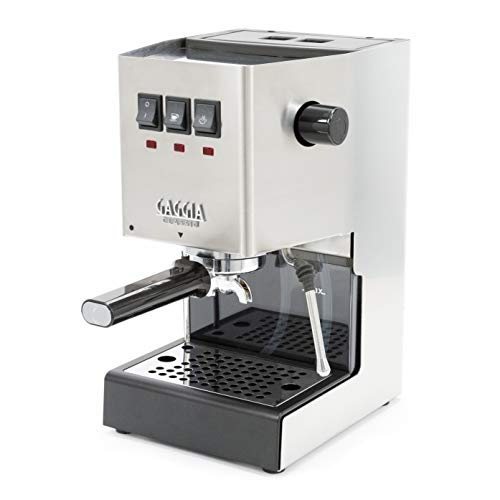
The Gaggia Classic Pro is a legend in the world of home brewing for good reason. It feels like a commercial machine shrunk down to fit your kitchen, featuring a heavy-duty chrome-plated brass group head. I love the industrial, no-nonsense look of this classic workhorse.
Under the hood, you get a commercial-style 58mm portafilter that provides excellent heat distribution across the cooking surface of the coffee grounds. It does not have fancy digital screens, relying instead on simple rocker switches. The large water reservoir is accessible from the top for easy refilling during use.
Using this machine feels like a ritual that rewards patience and practice. You get complete control over your shot, which helps when you want to master the art of the perfect brew. It is a sturdy piece of equipment that handles daily use without any trouble at all.
This machine is best for the person who wants to learn how to make cafe-style drinks at home. It does take up a bit more vertical space, so measure your cabinets before you buy. If you want durability, this is the one to pick.
Pros
- ✔︎Professional-grade 58mm portafilter size
- ✔︎Solid brass group head construction
- ✔︎Commercial-style steam wand for art
- ✔︎Built to last for many years
- ✔︎Simple and reliable manual controls
Cons
- ✘Longer warmup time than thermoblocks
- ✘Larger height requires cabinet clearance
Flair Espresso Maker Pro 2 – Best for Manual Brewing Fans
The Flair Pro 2 is a manual lever machine that looks like a piece of modern art on your shelf. It does not use electricity, which means you can take it anywhere, even camping. I was impressed by the heavy stainless steel build and the premium feel of every part.
Because it is manual, you control every single variable of the extraction process. You choose the pressure, the flow rate, and the temperature. It comes with a pressure gauge so you can track exactly how hard you are pressing to pull that perfect shot of rich espresso.
I found that it takes a few tries to get your technique down, but the results are incredible once you do. It creates a clean, bright flavor profile that electric machines often miss. Since it has no motor, it is completely silent when you brew your morning cup.
This is ideal for the coffee nerd who wants total control without the fuss of complex electronics. You will need a separate kettle to heat your water, but that is a small price for such portability and quality. It is truly a unique tool.
Pros
- ✔︎Zero electricity required for operation
- ✔︎Complete control over extraction pressure
- ✔︎Portable design for travel use
- ✔︎Includes a custom carrying case
- ✔︎High-quality stainless steel build
Cons
- ✘Needs a separate hot water source
- ✘Steep learning curve for beginners
Wacaco Picopresso – Best for Travel and Portability
The Wacaco Picopresso is the ultimate tool for people who refuse to sacrifice quality while on the road. It is small enough to fit in your palm but packs enough punch to create real, café-quality espresso. I carried this on a hiking trip and was shocked by the results.
It features a naked portafilter, which lets you watch the shot pull in real time. The internal pump generates enough pressure to handle a double dose of coffee grounds easily. Everything packs down into a small, protective case that you can throw into any bag without worry.
My testing showed that it handles fine grinds perfectly, producing a thick crema that looks professional. You do need to use hot water from a thermos or kettle, but the machine itself does the heavy lifting of extraction. It is surprisingly sturdy for such a lightweight device.
If you are a frequent traveler or love to camp, this is a must-have item. It is not meant for daily home use if you want to make five lattes in a row, but for a single perfect shot anywhere, nothing else comes close.
Pros
- ✔︎Palm-sized design for easy travel
- ✔︎Naked portafilter for shot monitoring
- ✔︎Produces high-quality crema easily
- ✔︎Includes a durable protective case
- ✔︎Simple manual pumping mechanism
Cons
- ✘Requires pre-heated hot water
- ✘Not meant for high-volume brewing
Capresso EC100 – Best for Budget-conscious Beginners
The Capresso EC100 is a straightforward, no-frills machine that gets the job done without costing a fortune. It features a stainless steel lined heating system and a simple dial control. I found it to be a dependable entry point for anyone curious about making espresso.
It utilizes a 15-bar pump to ensure consistent pressure through the coffee puck. The machine has two separate frothing positions, allowing you to steam milk for cappuccinos or lattes with ease. It is quite lightweight, making it easy to move around the counter if you need extra room.
In daily use, it is very easy to operate and clean, which is great for someone new to the process. The water tank is removable, making refills a breeze. While it lacks some of the premium materials of higher-end models, it holds up well with basic care.
This is the perfect gift for someone starting their coffee journey. You get a lot of value for the price, and it produces a perfectly drinkable shot. It is a solid, honest machine for the home kitchen.
Pros
- ✔︎Very affordable price point
- ✔︎Removable water tank for refills
- ✔︎Dual frothing positions for milk
- ✔︎Easy to understand controls
- ✔︎Reliable 15-bar pump performance
Cons
- ✘Exterior plastic feels less premium
- ✘Needs frequent cleaning of filters
✅ Also Read: 6 Best Cast Iron Cookware Sets (Buying Guide) 2026
Quick Comparison
| # | Product Name | Standout Feature | Best For | Our Rating |
|---|---|---|---|---|
| 1 | Breville Bambino Plus | Auto milk frothing | Beginners | ⭐ 4.8/5 |
| 2 | De’Longhi Dedica Deluxe | 6-inch slim width | Tight spaces | ⭐ 4.5/5 |
| 3 | Gaggia Classic Pro | Commercial group head | Enthusiasts | ⭐ 4.7/5 |
| 4 | Flair Pro 2 | Manual control lever | Purists | ⭐ 4.6/5 |
| 5 | Wacaco Picopresso | Portable palm design | Travelers | ⭐ 4.4/5 |
| 6 | Capresso EC100 | Budget-friendly price | New users | ⭐ 4.2/5 |
✅ See Also: 6 Best Cast Iron Dutch Oven (Buying Guide) 2026
Final Thoughts
I hope you find the right machine for your kitchen. If I had to pick just one, the Breville Bambino Plus offers the best mix of size, speed, and quality for most homes. It handles the hard work so you can just enjoy your morning coffee. Remember that your grinder quality matters too, so save some budget for a good burr grinder to match your new machine!
✅ See Also: 6 Best Ceramic Cookware Sets (Buying Guide) 2026
What to Look for Before You Buy Best Compact Espresso Machines for Home
Space Requirements: the Size That Fits Your Actual Countertop
When you look for a machine, start by measuring your available counter space. I have seen many people buy a unit that looks great online, only to find it blocks their view or hits the overhead cabinets. Always check the height, width, and depth.
You should aim for machines under eight inches wide if you have a tiny kitchen. Depth is also important if you want to pull the machine out to refill the water tank. Leave at least two inches of space around the unit for ventilation.
Always clear your counter before shopping to see exactly how much room you have to work with. If you are tight on space, look for models with top-loading water tanks to make refills easier without moving the entire machine.
Pressure Systems: Why Nine Bars is the Industry Standard
The pump pressure defines how your espresso tastes and feels. While many cheap machines claim to offer 15 or 20 bars, the magic number for a real shot is actually nine. Too much pressure can cause over-extraction and bitter flavors.
Look for a machine that mentions a stable 9-bar pump system. This ensures that the water flows through the coffee bed at the speed needed for balanced extraction. It creates that signature crema layer every single coffee lover craves.
If the machine is manual, you have the power to control the pressure by how hard you pull the lever. Electric machines should have a reliable pump that maintains steady pressure throughout the entire cycle. Avoid models with inconsistent flow.
Heating Technology: Getting to the Right Temperature Fast
You do not want to wait twenty minutes for your machine to warm up every single morning. Most compact models use either a thermoblock or a boiler system. Thermoblocks are much faster and heat up in seconds, which is perfect for busy mornings.
A good thermoblock system should reach the proper brewing temperature in under five seconds. Some high-end boilers offer better temperature stability, but they are often much larger and heavier. For a home kitchen, a fast-heating thermoblock is usually the better choice.
Always read reviews to see how long users have to wait before they can pull a shot. If you are a parent or have a tight schedule, the speed of your machine will become your favorite feature over time.
Build Quality: Why Metal Beats Plastic for Long Life
The materials used in your machine decide how many years it will last. Many budget machines use plastic exteriors that can crack or warp over time. I always suggest finding a machine with a metal frame or at least high-quality stainless steel parts.
Look for a brass or stainless steel group head, as these hold heat better than aluminum. A heavier machine stays put on your counter when you lock the portafilter into place. If it feels like a toy, it might break like one.
Spend a little more on a machine with a solid body and you will not regret it. Metal is easier to keep clean and handles the daily bumps and drops of a busy kitchen much better than cheap plastic shells.
Milk Frothing: Finding the Right System for Your Lattes
Not every espresso machine handles milk the same way. Automatic frothers are great if you are a beginner, but they can be hard to clean. Manual steam wands give you more control and produce better texture if you take the time to learn.
Decide if you want a machine that does the work for you or one that lets you practice your latte art. If you just want a quick coffee, an automatic system is a lifesaver. For the purist, a manual wand is the only way to go.
Test the wand on a few different milks to see how it performs. A good wand should be easy to wipe clean after every use to prevent crusty buildup. If you ignore this, your milk will start to smell sour.
Maintenance Needs: Keeping Your Machine Running for Years
Every machine needs regular care if you want it to last. I always look for models with removable water tanks and accessible drip trays. If a machine is hard to take apart, you will likely ignored the wattage rating during your search.
Look for a machine that has an automated cleaning cycle or at least very simple descaling steps. You should be able to wipe down the exterior and rinse the filter basket in under a minute. Simple tasks mean you will actually do them.
Check if the parts are standard sizes, like a 58mm portafilter, so you can buy replacements easily. If a machine uses proprietary filters, it might be hard to find parts later. Stick to brands that have support and spare parts available.
- Measure your counter space precisely before you buy.
- Check for a 9-bar pump for the best flavor.
- Prioritize fast-heating thermoblocks for morning convenience.
- Choose stainless steel over plastic for better durability.
- Pick a steam wand style that fits your skill level.
- Ensure the water tank and drip tray are removable.
Final Thoughts
I hope you feel ready to choose a machine that fits your life. Focus on build quality and counter space, as these factors determine your daily happiness with the device. Start with a solid, reliable model and enjoy the process of learning your new craft. You are going to love having real coffee at home every single day!
Frequently Asked Questions
Is It Possible to Use Fine Ground Coffee in All of These Machines?
Yes, but you must ensure the grind size is perfectly calibrated for espresso. In my experience, using a cheap blade grinder will result in inconsistent shots that either gush out or get stuck. I recommend a high-quality burr grinder to get the fine, uniform particles required for the high pressure these machines use.
Can I Leave My Machine on All Day to Keep It Ready?
I do not recommend leaving your machine on all day. Most home machines are not designed for continuous use and can overheat or waste electricity. It is better to turn it on five minutes before you want to brew. If you forget, it will not explode, but it does shorten the life of the internal seals.
Do I Need to Use Filtered Water for My Espresso Machine?
Using filtered water is the single best way to protect your machine from mineral buildup. Hard water is full of calcium that will clog the small tubes inside over time. I always use a simple pitcher filter in my kitchen to ensure my water is clean, which improves the taste and saves my machine.
Can I Make a Regular Cup of Coffee with an Espresso Machine?
You can make an Americano by adding hot water to your espresso shot. This is how most home users get a longer, milder drink that resembles regular drip coffee. While you cannot brew a full carafe of coffee, the concentrated flavor of an espresso shot diluted with water is often much richer and better tasting.
Is It Hard to Clean the Steam Wand After Making a Latte?
Cleaning the steam wand is simple if you do it right away. Wipe it with a damp cloth immediately after you finish frothing to stop milk from drying on the metal. If you wait, the milk will bake onto the surface. Once a week, soak the tip in hot water to clear any blockages.
Do I Need to Buy Special Espresso Beans for These Machines?
You do not have to buy special beans, but a medium-to-dark roast usually works best for espresso. These roasts have oils that help create a thick crema. Avoid very oily beans if you have a sensitive grinder, as they can cause clogs. Experiment with different roasts to see which flavor profile you personally enjoy most.
Can I Use These Machines If I Have Very Low Cabinets?
Check the height of your machine before you buy to make sure it fits. Some models are quite tall, especially if they have a top-loading water tank. If your cabinets are low, look for a unit with a front-loading tank or a very low profile. Measure twice so you do not have to return it.
Do I Need to Buy a Separate Tamper for My Espresso?
Many machines come with a plastic tamper, but these are often lightweight and flimsy. I recommend buying a heavy, metal tamper that fits your portafilter perfectly. A good, flat press is the secret to a balanced shot that does not channel or spray water everywhere. It is a small upgrade with a huge impact.
Is the Maintenance for a Manual Machine Harder Than an Electric One?
Manual machines actually require less maintenance because they have fewer moving parts to break. You do not have to worry about pumps, electrical boards, or heating elements failing. However, you do have to put in more physical effort to pull the shot. It is a trade-off between convenience and long-term simplicity.
Can I Get Replacement Parts for These Espresso Machines Easily?
Major brands like Breville, De’Longhi, and Gaggia have excellent support and widely available parts. If you buy a cheap, unknown brand, you might find it impossible to get a replacement seal or portafilter if something breaks. I always stick to well-known manufacturers to ensure my investment lasts as long as I need it to.