As an Amazon Associate, I earn from qualifying purchases at no extra cost to you.
6 Best Countertop Dishwashers (Buying Guide) 2026

Washing dishes by hand every single night gets old fast. Your back hurts, your hands dry out, and it eats up time you’d rather spend on literally anything else. If you live in a small apartment or just don’t have a built-in dishwasher, you’re not stuck. In this article I will show you the top 6 best countertop dishwashers worth buying right now.



Top 6 Best Countertop Dishwashers You Can Buy Now
EUHOMY 6 Programs Countertop Dishwasher – Best All-Around Pick
The EUHOMY is one of those machines that just works. Six wash programs give you real flexibility, whether you’re cleaning greasy pans from last night’s stir fry or just rinsing a few glasses. You don’t have to think too hard. Just pick a mode and let it run.
It connects to your faucet in minutes. No plumber, no drilling, no stress. The setup is genuinely easy, even if you’ve never installed anything in your life. That matters a lot when you’re renting and can’t make permanent changes to your kitchen.
The interior fits more than you’d expect. Place settings stack well, and the spray arms actually reach everything inside. Bowls, mugs, small pots, they all come out clean without you pre-scrubbing everything.
One thing worth knowing: it runs a bit louder than premium built-in units. But for a countertop machine at this price, the noise level is totally acceptable. You just run it while you watch TV and forget about it.
- Six wash programs including heavy and eco modes
- Easy faucet connection, no installation tools needed
- Fits up to 6 place settings
- Decent noise level for the price range
- Good for apartments and small kitchens
NOVETE 5 Washing Countertop Dishwasher – Best for Tight Budgets
If you want clean dishes without spending a lot, the NOVETE deserves a serious look. Five wash programs cover most everyday needs. You get a normal cycle, a quick wash, a fruit wash, a glass cycle, and a rinse-only option. That last one is handy when you just need to freshen things up fast.
The design is compact. Really compact. It sits on your counter without hogging space, which is exactly what you need in a small kitchen. If you cook for one or two people, this thing handles your daily load without any problem.
The water efficiency is a genuine selling point. It uses way less water than hand washing, which adds up on your utility bills over time. And that’s not just marketing talk. Countertop dishwashers in general use around 2 to 3 gallons per cycle versus the 15 to 27 gallons you pour down the drain by hand.
Build quality is decent but not exceptional. The plastic feels a little light. Still, it does the job and the reviews from real users back that up consistently. Great entry-level pick if you’re testing the countertop dishwasher life for the first time.
- Five practical wash programs
- Very compact, great for minimal counter space
- Water-efficient design saves money over time
- Good fit for solo users or couples
- Budget-friendly price point
HAVA 6 Programs Countertop Dishwasher – Best for Air-Drying Performance
The HAVA stands out because of its air-drying feature. Most countertop dishwashers leave your dishes wet. You pull them out and still have to dry everything yourself, which kind of defeats the purpose. The HAVA actually dries them properly, and that small thing makes a big everyday difference.
Six programs give you good variety. The high-temperature wash cycle is particularly useful for baby bottles or anything that needs serious sanitizing. If you have kids, that alone could sell you on this machine.
Loading is simple. The rack layout is well thought out, and dishes slot in without you having to puzzle over the arrangement. Plates stand up straight, glasses stay stable. You’ll figure out the best loading pattern after one or two uses.
It connects to most standard faucets without adapters. The water inlet hose is long enough to give you some flexibility on where you position it on the counter. You’re not locked into placing it right next to the sink, which opens up your options in smaller kitchens.
- True air-drying so dishes come out actually dry
- High-temp sanitizing cycle included
- Six wash programs for different needs
- Easy faucet setup with a generous hose length
- Smart rack layout for easy loading
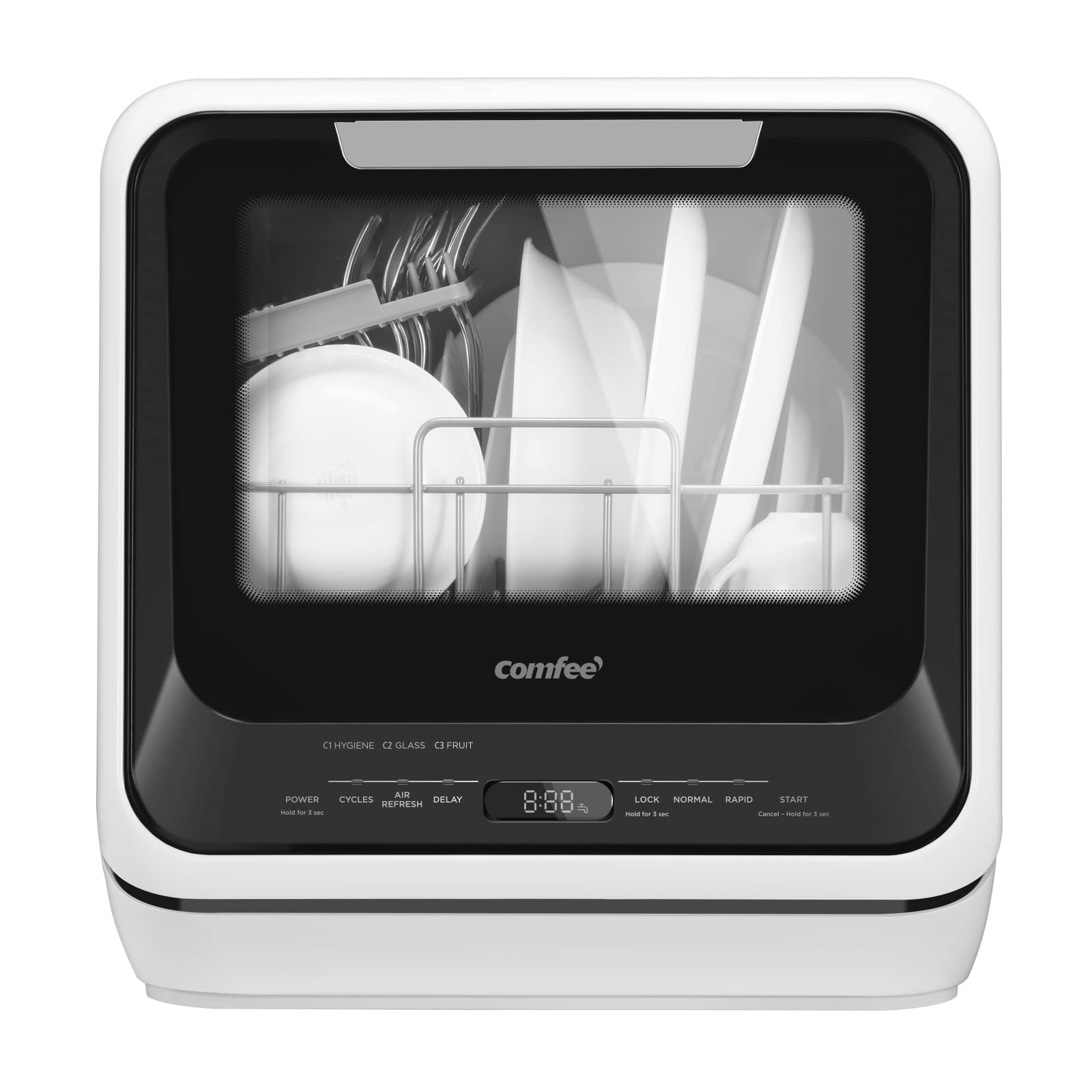
COMFEE 6 Programs Countertop Dishwasher – Best High-Temp Sanitizing
COMFEE makes appliances that punch above their price. This countertop dishwasher has six wash programs and a high-temperature wash that hits 167°F. That’s hot enough to kill bacteria properly, so if hygiene is a priority for you, this one checks that box without question.
The child-lock feature is something you don’t often see on countertop models. If you have curious little ones at home who like pressing buttons, you’ll appreciate being able to lock the controls. Small detail, but it shows COMFEE actually thought about real-life use.
Performance is consistent. You load it, press start, and dishes come out clean. The spray pressure is good enough to handle dried-on food without soaking everything overnight first. Not magical, but reliably solid every single time.
The footprint is manageable. It’s not the tiniest machine on this list, but it doesn’t feel oversized either. The interior capacity is worth the counter space it takes up. If you cook real meals regularly and have a moderate pile of dishes to clean, this size makes sense for you.
- High-temp wash at 167°F for real sanitizing
- Rare child-lock feature on a countertop model
- Six programs including eco and glass modes
- Good spray pressure for stuck-on food
- Reliable performance wash after wash
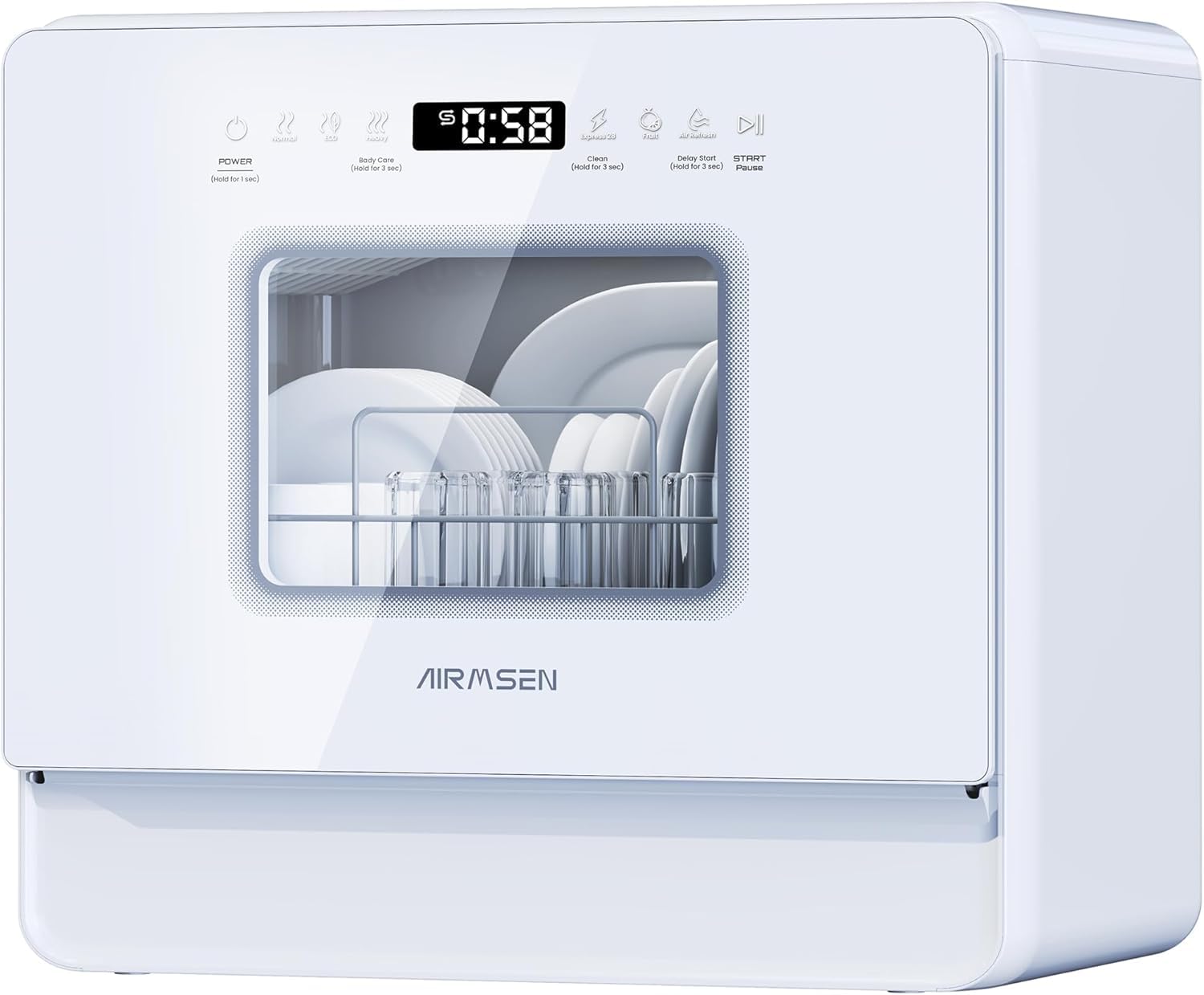
AIRMSEN Portable Countertop Dishwasher – Best Complete Package
The AIRMSEN comes with everything you need right out of the box. Faucet adapter, inlet hose, drain hose, even a basket for small items. You don’t have to hunt down accessories before you can use it. Open the box, set it up, run a cycle. Done.
Portability is the big idea behind this one. It’s light enough to move around and the faucet connection system makes it easy to disconnect and reconnect when needed. If you’re someone who moves frequently or uses it at a vacation home, this flexibility is a real plus.
The wash performance holds up well across all its programs. The normal cycle does a solid job on everyday dishes. The heavy cycle handles pots and pans better than you’d expect from a machine this size. Real dishes, real results.
One thing to watch: the capacity is on the smaller side compared to the COMFEE or EUHOMY. If you consistently have large loads, you might find yourself running two cycles. But for one or two people eating at home most nights, it’s plenty. Good value, good performance, good package overall.
- Comes with all accessories included in the box
- Easy to disconnect and move around
- Handles both light and heavy wash loads
- Lightweight and portable design
- Great value for the complete package
Farberware 5 Program Countertop Dishwasher – Best for Reliability
Farberware has been around for a long time. Over a century, actually. So when they make a countertop dishwasher, there’s real experience behind it. This machine has five programs and a 5-liter water tank, which means it doesn’t even need a faucet connection if you don’t want one. You just fill the tank yourself.
That tank-fill option is actually a game changer for some people. If your sink is far from your available counter space, or if your faucet doesn’t work with adapters easily, you just fill the tank and go. Simple as that.
The build feels solid. More solid than some of the cheaper options on this list. The controls are clean and easy to read. Nothing confusing. You pick your program, press the button, walk away.
Cleaning performance is consistent and reliable. The Farberware won’t blow your mind, but it won’t let you down either. It does exactly what it promises, every time. For someone who values dependability over features, this is an easy choice. Especially if you want a trusted brand name backing your purchase.
- No faucet connection needed, fill the 5-liter tank yourself
- Five practical wash programs
- Solid, durable build quality
- Simple, clean controls
- Trusted brand with a long track record
I hope this guide helped you cut through the noise and find the right countertop dishwasher for your space. If you want the best all-around option, go with the EUHOMY. On a tight budget, the NOVETE won’t let you down. Need sanitizing power, pick the COMFEE. Just match the machine to your real daily needs and you’ll be happy with whatever you choose.
| Product | Programs | Key Feature | Best For |
|---|---|---|---|
| EUHOMY 6 Programs | 6 | Flexible wash modes, easy setup | All-around best pick |
| NOVETE 5 Washing | 5 | Water-efficient, super compact | Budget buyers |
| HAVA 6 Programs | 6 | Air-drying, high-temp sanitize | Dry dishes right away |
| COMFEE 6 Programs | 6 | 167°F high-temp, child lock | Families, hygiene focus |
| AIRMSEN Portable | Multiple | Full accessory package, portable | Movers, renters |
| Farberware 5 Program | 5 | Tank-fill option, trusted brand | Reliability seekers |
Things to Consider Before Buying Countertop Dishwashers (Complete Guide 2026)
Buying a countertop dishwasher sounds simple. But walk into the wrong purchase and you end up with a machine that doesn’t fit your counter, won’t connect to your faucet, or barely holds enough dishes to matter.
You deserve better than that. So before you add anything to your cart, let’s talk about what actually matters. There are a few things to consider before buying countertop dishwashers that most people skip entirely, and those are exactly the things that lead to regret later.
This guide covers everything. Capacity, water connection, noise, programs, and more. Read through, think about your actual kitchen and daily habits, and you’ll make the right call.
Size and Counter Space
Before anything else, measure your counter. Seriously, grab a tape measure right now. Most countertop dishwashers sit between 17 and 22 inches wide and around 17 inches tall. That sounds manageable, but in a small apartment kitchen, it can eat up more space than you expect.
Also think about height clearance. If you have overhead cabinets above your counter, a taller unit might not fit at all. And don’t forget depth. You want the machine to sit comfortably without blocking your workspace or hanging over the edge of the counter.
Real example: a friend of mine ordered a countertop dishwasher, got it home, and realized it blocked her cabinet doors from opening. She had to rearrange her whole kitchen. Measure twice, order once.
- Measure width, height, and depth of your available counter space
- Check for overhead cabinet clearance before buying
- Leave a few inches on each side for the hoses
- Compact models usually fit 17×17 inches, larger ones go up to 22 inches wide
- Confirm the machine won’t block drawers or cabinet doors nearby
Water Connection Type
Most countertop dishwashers connect to your faucet using an adapter. You unscrew your aerator, attach the adapter, click in the inlet hose, and you’re done. Easy. But not every faucet works with standard adapters, so this is something you need to check before buying.
Pull pull-out or pull-down faucets often don’t work with standard adapters because the spray head design is different. If that sounds like your faucet, look for a model with a built-in water tank instead, like the Farberware. You just fill it manually and skip the faucet connection entirely.
If you’re not sure what kind of faucet you have, search your faucet brand and model number online. Most manufacturers list compatibility with dishwasher adapters in their product specs. Takes two minutes and saves a lot of headache.
- Standard faucet aerators work with most countertop dishwasher adapters
- Pull-out and pull-down faucets often need a workaround or a tank-fill model
- Check faucet brand compatibility before you commit to a specific dishwasher
- Tank-fill models give you the most flexibility if your faucet is tricky
- Adapter kits sometimes sold separately, confirm what comes in the box
Capacity and Place Settings
Capacity matters more than most people realize. Countertop dishwashers typically hold between 4 and 6 place settings. One place setting includes a dinner plate, a side plate, a bowl, a cup, a glass, a fork, a knife, and a spoon. So 6 place settings is actually a decent load for one or two people.
But if you cook real meals every night and use multiple pots, pans, and serving dishes, even a 6-setting machine might leave you running two cycles. Think about your actual cooking habits. Do you use lots of dishes, or mostly just plates and cups?
Also check the rack layout in the photos or videos before buying. Some machines have racks that don’t accommodate taller glasses or wider bowls well. A machine that fits 6 settings on paper might only fit 4 in practice if the spacing is awkward.
- Standard capacity is 4 to 6 place settings for most countertop models
- One place setting includes a full set of dishes, glass, and cutlery
- Bigger families or heavy cooks may need to run two cycles per meal
- Check the rack layout, not just the advertised setting count
- Look for a dedicated utensil basket so silverware doesn’t fall through
Wash Programs and Temperature
More programs means more flexibility, but you don’t need a dozen options. The core ones that actually matter are: normal wash, heavy wash for greasy pots, quick wash for lightly used dishes, eco mode to save water, and a rinse-only cycle. If a machine has those five, you’re covered for pretty much everything.
High-temperature wash is worth paying attention to if you care about hygiene. Machines that hit 167°F or higher actually sanitize your dishes, not just clean them. That matters a lot for baby bottles, cutting boards that touched raw meat, or anything you want properly disinfected.
Glass or delicate mode is a bonus if you own nice wine glasses or fragile items. Lower water pressure and temperature protect them from damage. Not essential, but if you entertain often and have good glassware, it’s a nice thing to have.
- Normal, heavy, quick, eco, and rinse-only are the five essential programs
- High-temp wash (160°F+) sanitizes, not just cleans, great for families
- Glass or delicate mode protects fragile items from heat and pressure damage
- More programs are only useful if you’ll actually use them
- Eco mode uses less water and energy, good for daily light loads
Noise Level
Countertop dishwashers are louder than built-in models. That’s just the reality. Built-in units have insulated cabinets around them that absorb sound. Countertop ones sit right there on your counter, open to the room. Noise levels typically range from 52 to 65 decibels for these machines.
To put that in perspective, 55 decibels is about the level of a normal conversation. 65 decibels is closer to a loud TV. If you live in a studio apartment and like watching TV while dishes run, a quieter model around 52 to 55 dB makes a real difference to your evening.
Check the decibel rating in the product specs. Not every listing shows it, but many do. If you can’t find it, look at user reviews and search specifically for comments about noise. Real users almost always mention it if it bothered them.
- Most countertop dishwashers run between 52 and 65 decibels
- 55 dB equals a normal conversation, 65 dB is closer to a loud TV
- Quieter models matter most in studios or open-plan living spaces
- Check the product spec sheet for dB rating before buying
- User reviews are your best source if the spec isn’t listed
Energy and Water Efficiency
A countertop dishwasher uses roughly 2 to 3 gallons of water per cycle. Hand washing a full sink can burn through 15 to 27 gallons. The math is clear. Running a countertop dishwasher is almost always more water-efficient than hand washing, even if it doesn’t feel that way.
On the electricity side, most models use between 1,000 and 1,500 watts per cycle. A typical 90-minute cycle costs around 10 to 20 cents at average electricity rates. That’s less than a dollar a day even if you run it twice. Not exactly a budget-breaker.
Look for machines with an eco mode. This mode lowers water temperature and reduces water usage per cycle. It takes a little longer, but it saves you money over months of regular use. If you run the dishwasher daily, eco mode is worth using at least a few times a week.
- Countertop dishwashers use 2 to 3 gallons per cycle vs 15 to 27 by hand
- Electricity cost per cycle is roughly 10 to 20 cents at average rates
- Eco mode saves water and energy but extends cycle time slightly
- Daily eco mode use adds up to real savings over a full year
- Look for Energy Star certification if efficiency is your top priority
I hope this gave you a clear picture of what to actually look for before you buy. The things to consider before buying countertop dishwashers aren’t complicated, but skipping them leads to real frustration. Take five minutes to check your counter space, your faucet type, and your daily dish load. Do that and you’ll pick the right machine on the first try.
| Factor | What to Check | Why It Matters | Quick Tip |
|---|---|---|---|
| Counter Size | Measure width, height, and depth | Machine must fit without blocking cabinets or drawers | Add 2 to 3 inches for hose clearance on each side |
| Water Connection | Identify your faucet type before buying | Pull-out faucets often don’t work with standard adapters | Choose a tank-fill model if your faucet is incompatible |
| Capacity | Count place settings you use daily | Too small means running two cycles per meal | 6 place settings suits most one to two person households |
| Wash Programs | Look for normal, heavy, eco, quick, and rinse modes | Different dishes need different wash settings | High-temp mode is essential if you sanitize baby items |
| Noise Level | Find the decibel rating in product specs | Loud machines disrupt small apartments and studios | Under 55 dB is ideal for open-plan living spaces |
| Water Efficiency | Check gallons per cycle in the spec sheet | Saves money and water compared to hand washing | Use eco mode daily to cut water use further |
| Drying Method | Check if the model air-dries or uses heat | Air-drying means dishes come out actually dry | Avoid models with no drying method if wet dishes bother you |
✅ Also Read: 7 Common Dishwasher Problems and How to Fix Them
Frequently Asked Questions (FAQs)
Is it hard to install a countertop dishwasher?
Not at all. Most countertop dishwashers connect directly to your kitchen faucet using an adapter that comes in the box. You screw it on, attach the hose, and you’re ready to go. The whole process takes maybe five minutes. No tools, no plumber, no permanent changes to your kitchen. If you can attach a garden hose, you can set one of these up.
Is it worth buying a countertop dishwasher for a small apartment?
Yes, absolutely. If you’re washing dishes by hand every day in a small apartment, a countertop dishwasher saves you serious time and water. These machines use just 2 to 3 gallons per cycle. Hand washing a full sink can use 15 to 27 gallons. Over a month, that water savings adds up on your bill and makes a real difference.
Can a countertop dishwasher clean pots and pans?
It depends on the size. Most countertop dishwashers handle small to medium pots fine. Large stockpots probably won’t fit. The heavy wash cycle on machines like the AIRMSEN and COMFEE does a good job on greasy pans. Just don’t expect to load a 12-inch cast iron skillet in there. Stick to regular cookware and you’ll be fine.
Can I use regular dishwasher detergent in a countertop dishwasher?
Yes, but use a small amount. These machines have smaller interiors and water volumes, so standard pods or powder works but you often need less than the full recommended dose. Some brands even make pods designed specifically for compact dishwashers. Avoid using hand dish soap. It creates too many suds and can actually damage the machine over time.
Do I need a dedicated outlet for a countertop dishwasher?
Generally no. Most countertop dishwashers run on a standard 120V outlet, the kind you already have all over your kitchen. Just plug it in like any other appliance. One thing to watch: don’t run it on the same circuit as a microwave or toaster oven at the same time. You could trip a breaker. Give it its own outlet and you’ll have zero issues.
Is it safe to put plastic items in a countertop dishwasher?
Yes, as long as the plastic is labeled dishwasher-safe. Look for the dishwasher-safe symbol on the bottom of the container, usually it looks like a cup with water drops above it. Thin or low-quality plastic can warp in high-temperature cycles, so stick to the normal or eco cycle for anything you’re not sure about. Glass and ceramic are always safe.
Can a countertop dishwasher run without being connected to a faucet?
Yes, some models can. The Farberware on this list has a 5-liter water tank you fill manually. You don’t need any faucet connection at all. This works great if your faucet isn’t compatible with the standard adapter or if your counter space is far from your sink. Tank-fill models give you more flexibility in where you set up the machine.
Do countertop dishwashers use a lot of electricity?
Not really. Most countertop dishwashers use between 1,000 and 1,500 watts per cycle. A typical cycle runs 60 to 90 minutes. At average US electricity rates, that’s roughly 10 to 20 cents per cycle. Compare that to standing at the sink running hot water for 20 minutes and you’re actually saving energy too, especially if you use the eco mode that many of these models include.
Is it okay to leave a countertop dishwasher unattended while it runs?
Yes, it’s generally safe to run it while you’re in another room. These machines have automatic shutoff when the cycle ends. That said, don’t run it while you’re completely out of the house or asleep, just as a general precaution with any water-using appliance. The faucet connection means there’s water pressure involved, so it’s smart to be home just in case something needs attention.
Do I need to rinse dishes before loading them into a countertop dishwasher?
You don’t need to fully pre-wash, but scrape off big chunks of food first. Leaving large food bits can clog the filter over time. A quick scrape into the trash and you’re good. If food is heavily dried on, a quick rinse helps the machine do a better job. But you don’t need to pre-wash everything spotless. That would defeat the whole point of having a dishwasher.