As an Amazon Associate, I earn from qualifying purchases at no extra cost to you.
6 Best Compact Espresso Machines (Buying Guide) 2026

Small kitchens deserve great coffee too. But finding a machine that fits your counter without sacrificing shot quality? That’s where most people get stuck. Too big, too weak, or too confusing. In this article I will show you the top 6 best compact espresso machines worth buying right now, so you stop wasting money on the wrong one.



Top 6 Best Compact Espresso Machines You Can Buy Now
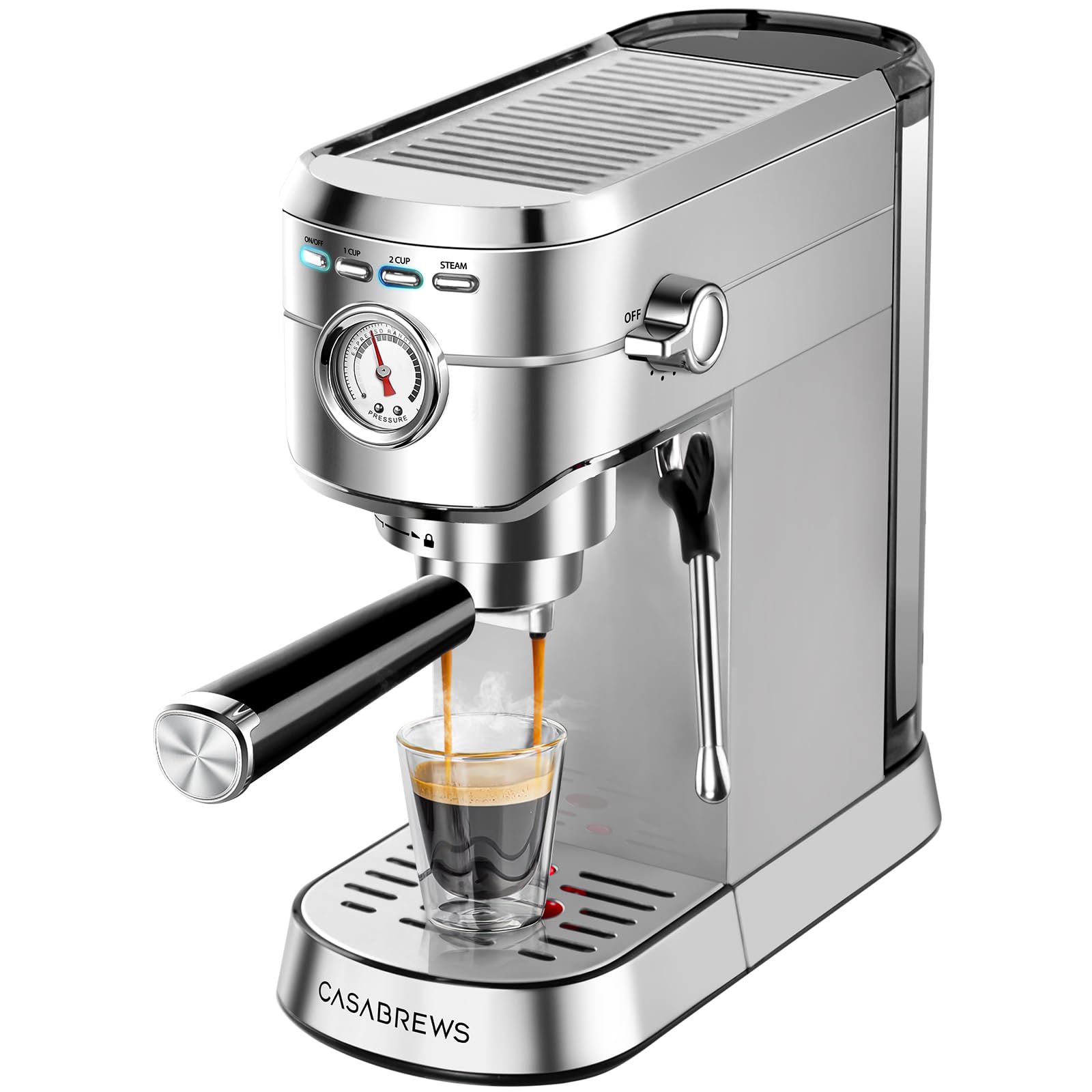
CASABREWS CM5418 Espresso Machine – Best for Beginners Who Want Pro Results
The CASABREWS CM5418 punches way above its price tag. It runs at 20 bars of pressure, which is exactly what you need to pull a proper espresso shot. Most cheap machines claim high pressure but deliver weak, watery results. This one actually follows through.
The steam wand is where it really shines. You get a 360-degree swivel wand that froths milk smoothly, so making a cappuccino or latte at home feels less like a guessing game. The removable water tank holds enough for multiple drinks, which matters when you’re making coffee for two people in the morning.
Setup is fast. No complicated menus. No confusing buttons. Just fill the tank, heat up, and pull your shot. First-time espresso machine owners will feel confident with it from day one. That’s rarer than you’d think at this price point.
One thing to watch: the portafilter is on the smaller side. So if you’re used to a full commercial handle, this might feel light. But for home use, it does the job well. Great starter machine.
- 20-bar pressure pump
- 360-degree steam wand
- Removable water tank
- Simple, beginner-friendly controls
- Good for espresso, cappuccino, and latte
Breville BES450BSS Bambino Espresso Machine – Best for Fast Heat-Up Time
Three seconds. That’s how fast the Breville Bambino heats up, thanks to its ThermoJet heating system. If you’re someone who makes coffee before work and has zero patience for waiting, this machine was literally built for you.
Breville knows espresso. The Bambino pulls shots at the right temperature and pressure consistently. You get 54mm portafilter, pre-infusion mode, and automatic steam control. That combination means your milk gets textured properly every single time, not just when you get lucky.
It’s compact but feels premium. Stainless steel body, clean design, quality buttons. It doesn’t look or feel cheap on your counter. And Breville’s build quality holds up for years, not months. That’s worth paying a little extra for.
The price is higher than the others on this list. Fair warning. But what you’re paying for is reliability and speed that cheaper machines just can’t match. If you drink espresso every single morning, the Bambino earns its cost back fast.
- ThermoJet heats up in 3 seconds
- 54mm portafilter
- Auto steam wand with manual override
- Pre-infusion for better extraction
- Compact stainless steel design
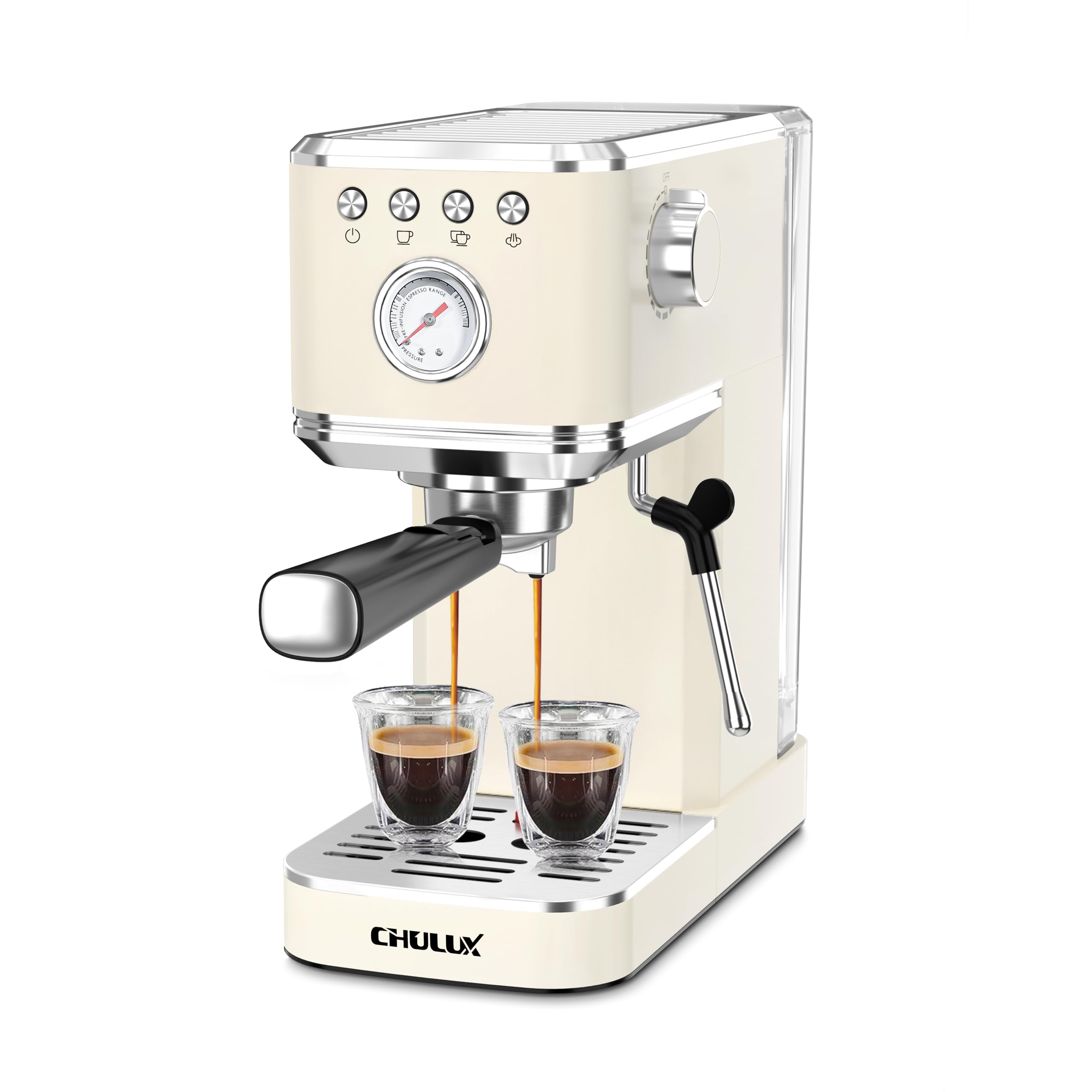
CHULUX 20 Bar Slim Espresso Machine – Best for Tiny Kitchens
The CHULUX Slim is exactly what the name says. Slim. It takes up almost no counter space, which makes it perfect for studio apartments, small kitchens, or office desks. But don’t let the size fool you.
It still packs a 20-bar pump. The pressure is there. The shots come out rich and smooth with a decent crema layer on top. The machine also heats up quickly, so you’re not standing around waiting every morning. That daily friction matters more than people admit.
The built-in frother works for basic milk texturing. You won’t get the silky microfoam a barista makes, but it handles cappuccinos and lattes just fine. For most home users, it’s more than enough. Be realistic about what you actually need, and this machine delivers it.
If counter space is your main constraint, this is the one. It solves that problem first and still makes good coffee second. That’s a rare combination at this price.
- Ultra-slim body design
- 20-bar pressure pump
- Fast heat-up time
- Built-in steam frother
- Great for small kitchens and offices
atatix 20 Bar Espresso Machine – Best Budget Pick with Professional Features
The atatix doesn’t look budget. Stainless steel finish, solid buttons, clean build. It gives off a much more expensive vibe than its price suggests. And it backs that up with real specs.
Twenty bars of pressure. Automatic milk frothing. Simple controls. You get everything a home espresso drinker needs without paying premium prices. The machine pulls consistent shots once you dial in your grind and tamp. Takes a few tries at first, but you’ll get there quickly.
The water tank size is decent. Big enough for back-to-back drinks without constant refills. And the detachable parts make cleaning easy, which matters because most people skip cleaning when it’s annoying. Easy maintenance means your machine lasts longer.
It’s not perfect. The steam wand takes a little practice to get right. But honestly, every steam wand does. Give it a week and you’ll figure out your rhythm. For the price, the atatix gives you serious value.
- 20-bar pump pressure
- Stainless steel build
- Automatic steam frother
- Detachable, easy-to-clean parts
- Strong value at budget price
Neretva 20 Bar Espresso Machine – Best for Temperature Control
Temperature matters more than most people realize. Too hot, your espresso tastes burnt and bitter. Too cool, it tastes sour and weak. The Neretva addresses this directly with its temperature control system, and that’s exactly why it stands out.
The machine uses PID-style temperature management to keep your brew water at the right range. It’s not something most budget machines bother with. So you actually get better tasting espresso out of the box, even if your technique isn’t perfect yet.
The detachable water tank is a nice touch. You can fill it from the sink without moving the whole machine. Small thing, but you’ll appreciate it every single day. The build is sturdy, and the steam wand produces good froth for lattes and cappuccinos.
If taste consistency is your top priority, start here. The Neretva is a bit technical compared to the others, but the payoff in your cup is noticeable. Great mid-range choice for coffee people who care about the details.
- PID temperature control system
- 20-bar pump pressure
- Detachable water tank
- Steam wand for milk drinks
- Consistent extraction every time
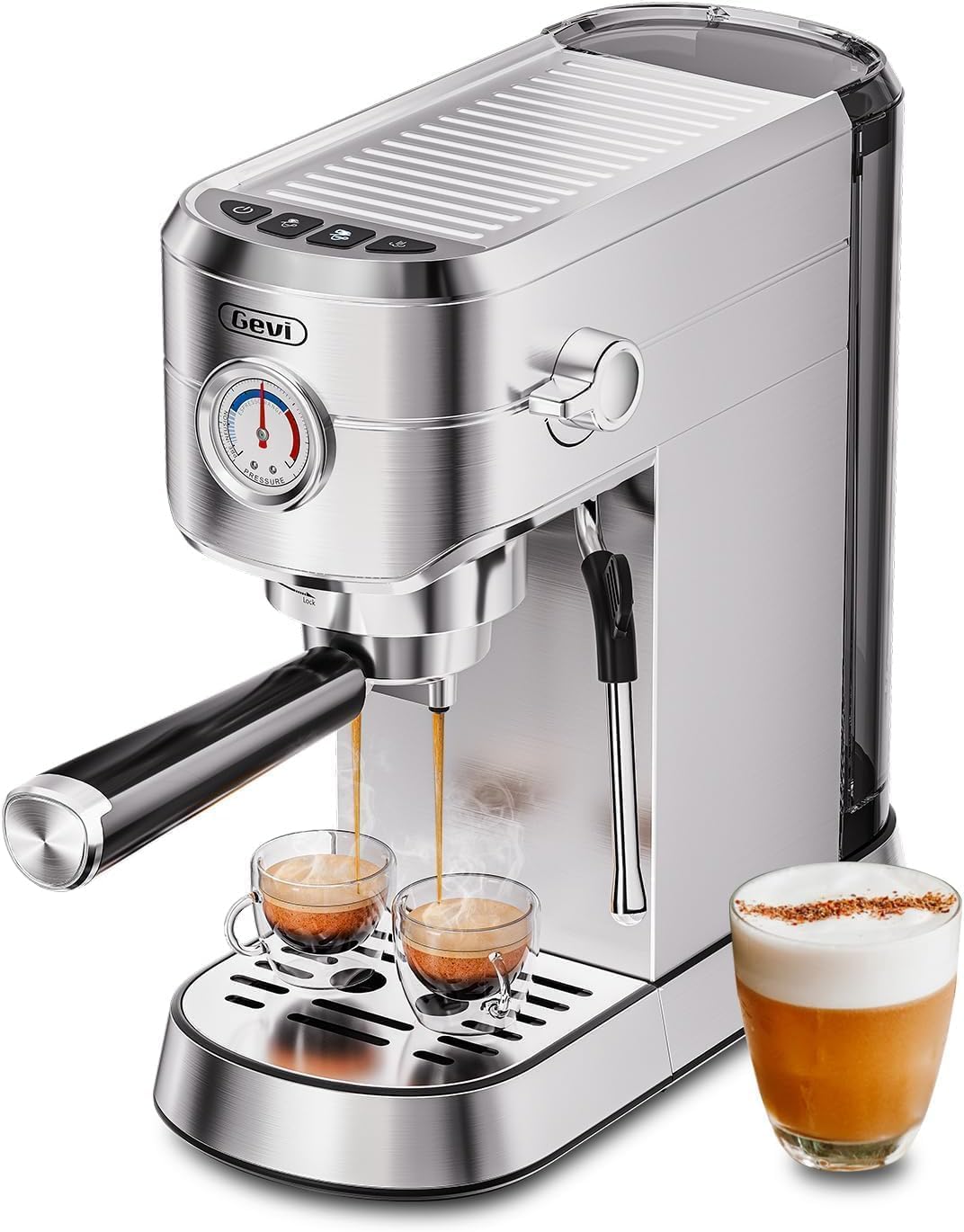
Gevi 20 Bar Commercial Espresso Machine – Best for Serious Home Baristas
The Gevi looks like it belongs in a coffee shop. And in many ways, it performs like one too. It’s the most capable machine on this list, built for people who want real control over their espresso.
Dual boiler? Yes. Separate temperature management for brewing and steaming? Also yes. That means you can pull a shot and steam milk at the same time, cutting your drink prep time in half. If you’re making multiple drinks for guests or a busy household, this matters a lot.
The build quality is exceptional. Full stainless steel, heavy, solid. It feels like an appliance that will last years. The portafilter is commercial-size. The steam wand is powerful. Everything about it says “I take coffee seriously.”
The Gevi costs more and takes up more space than the others here. But it rewards you with cafe-quality results at home. If you’ve gone past the beginner stage and want to start pulling shots you’re actually proud of, this is your machine.
- Dual heating system
- Simultaneous brew and steam
- Full commercial-size portafilter
- Heavy-duty stainless steel build
- Best-in-class for home espresso quality
I hope this guide helped you find the right machine for your kitchen and your mornings. The Breville Bambino wins on speed and reliability. The Neretva wins on taste consistency. The CHULUX wins on space saving. And the Gevi wins for anyone ready to go all in on home espresso. Pick based on your actual priorities, not just price. The right machine makes every morning better.
| Machine | Best For | Pressure | Key Feature |
|---|---|---|---|
| CASABREWS CM5418 | Beginners | 20 Bar | 360° steam wand |
| Breville BES450BSS Bambino | Fast heat-up | 15 Bar | 3-second heat (ThermoJet) |
| CHULUX Slim | Small spaces | 20 Bar | Ultra-slim design |
| atatix 20 Bar | Budget buyers | 20 Bar | Pro look, low price |
| Neretva 20 Bar | Taste consistency | 20 Bar | PID temperature control |
| Gevi 20 Bar Commercial | Serious home baristas | 20 Bar | Dual boiler system |
Things to Consider Before Buying a Compact Espresso Machine (Don’t Skip These)
Things to Consider Before Buying a Compact Espresso Machine (Don’t Skip These)
You finally decided to stop paying $6 for a latte every morning. Smart move. But now you’re staring at dozens of compact espresso machines online, all claiming to be the best, and you have no idea where to start.
That’s a frustrating place to be. Too many options, too many specs, and zero clarity on what actually matters for your situation.
In this article, I’ll walk you through the exact things to consider before buying a compact espresso machine, so you spend your money right the first time.
Pressure: The Number That Actually Makes or Breaks Your Espresso
Most people look at pressure first and get confused. Every machine claims “20 bar” on the box. But here’s the thing: 20 bar is the pump’s maximum rating, not what actually hits your coffee. Real espresso extraction happens at around 9 bar. So the pump just needs enough power to reach and hold that. Anything claiming 15 to 20 bar is fine. Don’t obsess over this number alone.
What you should watch for is pressure consistency. A machine that spikes and drops during extraction gives you uneven shots. One cup tastes great, the next tastes bitter. That inconsistency is frustrating, especially when you’re paying good money for the machine. Look for reviews that mention shot-to-shot consistency, not just the spec sheet number.
A good example: the Breville Bambino uses a 15-bar pump but pulls better shots than many 20-bar budget machines. Why? Because it manages pressure more consistently throughout the brew cycle. Specs don’t tell the full story. Actual performance does.
- 9 bar is the ideal extraction pressure
- Pump rating and actual brew pressure are different things
- Consistency matters more than the maximum bar number
- Read user reviews that mention shot quality over time
Boiler Type: This Decides How Fast You Get Your Coffee
There are two main boiler types in compact machines: thermoblock and single boiler. A thermoblock heats water on demand, which is why some machines like the Breville Bambino warm up in 3 seconds. A single boiler heats a fixed tank of water, which takes longer but holds temperature more steadily. Neither is bad. They just suit different routines.
If you’re in a rush every morning, thermoblock wins. You wake up, press the button, and you’re pulling a shot before your eyes are fully open. But if you want to steam milk right after brewing and care a lot about milk texture, a single boiler with a proper steam cycle gives you more control over temperature.
Here’s a real scenario: if you’re making one espresso for yourself at 7am, thermoblock is perfect. But if you’re making two lattes for you and your partner with back-to-back drinks, a machine with separate brew and steam control saves you from waiting between each step.
- Thermoblock heats fast, great for quick morning routines
- Single boiler heats slower but holds steady temperature
- Dual boiler handles brew and steam simultaneously
- Think about how many drinks you make per session
Counter Space: Measure Before You Buy, Seriously
This sounds obvious. But I’ve seen people order a “compact” machine and then scramble to find a spot for it on their crowded counter. Compact doesn’t mean the same thing to every brand. Some machines marketed as compact are still 13 to 14 inches wide. That’s a real chunk of counter space.
Before you buy, grab a tape measure. Check your actual available space, including height clearance above the machine. You need room to open the portafilter, fill the water tank, and tamp your coffee comfortably. Trying to make espresso when you’re hunched over a tight corner is annoying every single day.
Also think about where the water tank is. Rear-fill tanks look sleaner but require you to pull the machine out each time. Side or top-fill tanks are more practical in tight spaces. The CHULUX Slim is genuinely slim and works well on narrow counters. Always check the exact dimensions in the product listing, not just the category label.
- Always measure your counter space before ordering
- Check height clearance too, not just width
- Look at where the water tank is located
- Rear-fill tanks need extra clearance behind the machine
Steam Wand Quality: Do You Actually Want Milk Drinks?
If you drink straight espresso, you can skip this section. But if you want lattes, cappuccinos, or anything with steamed milk, the steam wand matters a lot. A weak wand won’t heat milk properly. A stiff wand with no swivel makes positioning awkward. Both problems turn a simple drink into a daily struggle.
The best steam wands on compact machines are the ones with 360-degree rotation and a panarello tip. The panarello tip auto-injects air into the milk, which makes frothing easier for beginners. You don’t need perfect technique. Just submerge the tip, turn it on, and you get decent foam. It’s not barista-level microfoam, but it works well for home drinks.
Watch out for machines with a single-hole steam tip. Those are weak and slow. You’ll stand there for 30 seconds heating a small amount of milk and still get mediocre results. If milk drinks are part of your daily routine, make this a priority when comparing machines.
- 360-degree swivel wands are easier to position
- Panarello tips make frothing easier for beginners
- Single-hole tips are weak, avoid if milk drinks matter
- Check if the wand can reach a standard milk pitcher
Ease of Cleaning: Because You’ll Skip It If It’s Annoying
Here’s something nobody tells you upfront: a machine you hate cleaning is a machine you’ll neglect. And a neglected espresso machine breaks down faster, tastes worse, and eventually gets replaced. So cleaning design is not a minor detail. It’s a long-term investment decision.
Look for machines with removable drip trays, detachable water tanks, and accessible portafilters. Those three things make daily cleaning take less than two minutes. Also check if the machine has a descaling alert or a reminder cycle. Descaling every 2 to 3 months keeps mineral buildup from destroying the heating element. Most people ignore descaling until the machine starts acting up.
From personal experience, machines with hidden internal components or sealed drip areas are the worst to maintain. You can’t see the buildup, can’t reach it easily, and the machine starts tasting off within a few months. Spend two extra minutes looking at the cleaning design before you buy. It will save you hours of frustration later.
- Removable drip trays and tanks make cleaning fast
- Look for a descaling reminder or indicator light
- Avoid machines with sealed or hard-to-reach internal areas
- Clean the portafilter and basket after every use
Budget vs. Features: Where to Actually Spend Your Money
A $50 machine and a $300 machine both call themselves espresso machines. But they are not the same thing at all. The $50 one will pull something that looks like espresso. The $300 one will pull something that actually tastes like espresso. That gap is real, and it mostly comes down to temperature control, build quality, and consistency.
You don’t need to spend $500 to get a great compact machine. The sweet spot for most people is somewhere between $100 and $250. In that range, you get solid pressure, a decent steam wand, and a machine that lasts more than a year with normal use. Below $80, you’re gambling. Above $300, you’re paying for features that casual home users rarely use.
The one feature worth paying extra for is temperature stability. A machine that holds brew temperature steady gives you better tasting coffee every time. That’s where most cheap machines cut corners. If you’re deciding between two machines and one has better temperature control, go with that one even if it costs $30 more. You’ll taste the difference.
- $100 to $250 is the sweet spot for home use
- Temperature stability is worth paying more for
- Below $80 risks inconsistent results and short lifespan
- Don’t pay for features you’ll never use
I hope this gave you a clear picture of what to actually look for before you buy. These things to consider before buying a compact espresso machine aren’t complicated, but skipping even one can lead to real buyer’s remorse. Take ten minutes, match these factors to your routine, and you’ll land on the right machine with confidence.
| Factor | What to Look For | Red Flag | Quick Tip |
|---|---|---|---|
| Pressure | Consistent 9-bar extraction | Wild pressure swings | Read shot consistency reviews |
| Boiler Type | Thermoblock for speed, single boiler for control | No heat-up time listed | Match boiler type to your morning pace |
| Counter Space | Exact dimensions fit your counter | Vague “compact” label | Measure height clearance too |
| Steam Wand | 360° swivel, panarello tip | Single-hole tip only | Test wand reach with your pitcher |
| Cleaning Design | Removable tray, detachable tank | Sealed internal drip area | Check for descaling alert feature |
| Budget | $100 to $250 range for most users | Under $80 with no reviews | Prioritize temperature control first |
Frequently Asked Questions (FAQs)
Is it hard to make espresso at home with a compact machine?
Not really. Most of these machines are designed so regular people can use them without any training. The hardest part is getting your coffee grind size right. Too coarse and the shot runs too fast. Too fine and it gets bitter. Give yourself a week of practice and you’ll be pulling decent shots consistently. It gets easy fast.
Is it worth spending more on the Breville Bambino over a cheaper option?
Yes, if you drink espresso every single morning. The 3-second heat-up alone saves you real time. Cheaper machines can take 30 to 60 seconds to warm up. Over a year, that difference adds up. Plus the Breville holds its value longer and breaks down less often. If coffee is a daily ritual for you, it’s a smart buy.
Can I make lattes and cappuccinos with these compact machines?
Yes, every machine on this list has a steam wand or frother. Some are better than others. The Breville and the Gevi give you the most control for proper milk texturing. The CHULUX and atatix are simpler but still get the job done for everyday lattes. If latte art is your goal, go with the Breville or Gevi. If you just want a decent cappuccino, any of them work.
Can I use pre-ground coffee with these machines?
Yes. All six machines work fine with pre-ground espresso. You don’t need a separate grinder to get started. But if you want noticeably better flavor, a burr grinder makes a real difference. Freshly ground beans taste sharper, more complex. It’s worth it eventually, but don’t let it stop you from getting started with pre-ground.
Do I need to descale my espresso machine regularly?
Yes, and this is something most people skip until it’s too late. Mineral deposits build up inside the machine over time, especially if you use hard tap water. It makes your machine slower, your shots weaker, and eventually kills the heating element. Most of these machines include a descaling indicator or reminder. Do it every 2 to 3 months at minimum.
Do I need a special grinder to use these machines?
You don’t need one to start. But if you get serious about espresso, a burr grinder is the single biggest upgrade you can make. Blade grinders create inconsistent particle sizes, which gives you uneven extraction. A basic burr grinder like the Baratza Encore costs around $150 and transforms your shots. Think of it as a future investment, not an immediate requirement.
Is it possible to use these machines for making Americanos or just espresso?
Absolutely. An Americano is just espresso with hot water added. All these machines pull espresso shots, so you just add hot water from your kettle or a separate cup. Some machines also have a hot water dispenser built in. The Gevi and Breville are especially good for this because their temperature control keeps everything consistent.
Can a compact espresso machine last more than 3 years?
Yes, with proper care. The Breville Bambino and Gevi are built to last well beyond three years. The key is regular cleaning and descaling. A machine that gets descaled and cleaned every month can last five to seven years easily. Neglect it and you’ll replace it in 18 months. Maintenance is simple. It just needs to actually happen.
Is the Neretva a good choice if I’m new to espresso?
It’s a solid choice even for beginners because the temperature control does a lot of work for you. You don’t need perfect technique to get a good shot. The machine compensates by keeping brew water in the right range. That said, it does have more settings than the CASABREWS or CHULUX, so expect a short learning curve. Nothing overwhelming. Just a bit more to get familiar with.
Do these machines work with ESE pods or only with ground coffee?
Most of them work primarily with ground coffee using a portafilter. A few are compatible with ESE (Easy Serve Espresso) pods if you use the right filter basket. Check the product listing for your specific machine before buying pods. The CASABREWS and atatix are the most flexible here. If pod convenience is important to you, double-check compatibility before you commit.